
How To
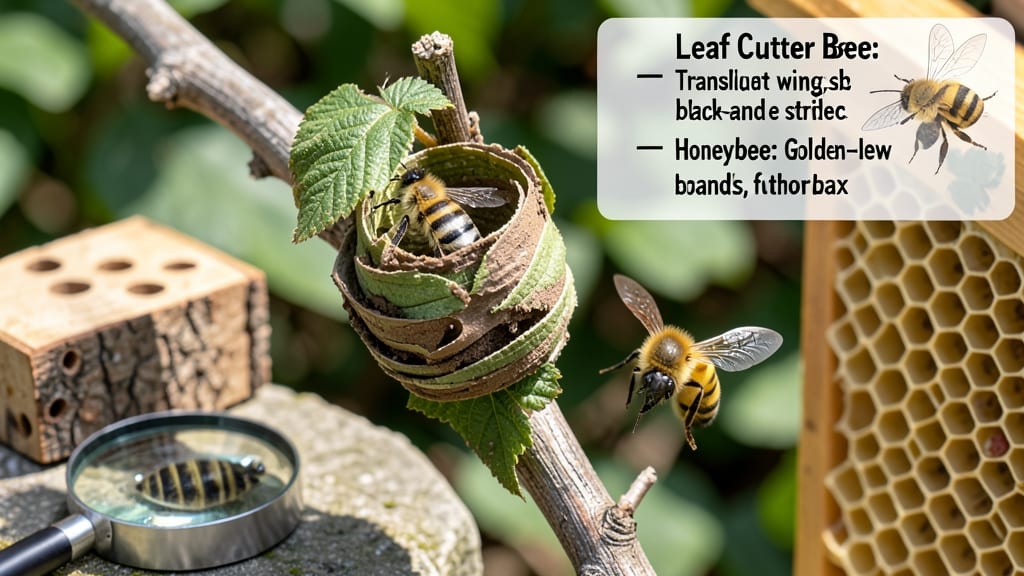
Leaf cutter bees do not make honey; instead, they collect pollen and nectar to provision nests they excavate in plant stems, leaves, or wood. Their primary role is pollination, not honey production, though they contribute significantly to garden ecosystems.
Leaf cutter bees are often confused with honeybees because of their pollination work, but their behaviors differ completely. 🌿 These solitary bees focus entirely on creating nests by cutting circular sections from leaves, which they use to line their burrows.
Unlike honeybees, they don't produce honey or live in colonies—they're all about pollinating plants while building their individual homes.
What makes them so valuable is their precision as pollinators. They visit flowers in a way that transfers pollen more effectively to certain crops like tomatoes and blueberries. Their leaf-cutting habit also creates unique patterns in foliage, which gardeners can spot as telltale signs of their activity.
The key difference? While honeybees store honey for colony survival, leaf cutter bees are all about creating the perfect nursery for their offspring.
💡 In This Article
- How Leaf Cutter Bees Differ From Honeybees
- Supporting Leaf Cutter Bees in Your Garden
How leaf cutter bees differ from honeybees
Leaf cutter bees operate on a completely different biological blueprint than honeybees. While honeybees live in large colonies of up to 60,000 individuals working together to produce honey, leaf cutters are solitary creatures.
Each female builds her own nest, typically excavating tunnels in soft wood or existing plant stems, where she'll raise just 4-10 offspring per season.
The key difference lies in their pollen storage: honeybees pack pollen into hexagonal cells with nectar to create honey, while leaf cutters simply collect pollen balls and pack them into their leaf-lined brood cells.
Their nest construction reveals fascinating behavioral differences. Leaf cutter bees use their powerful mandibles to cut precise semi-circular sections from leaves (typically 1/4 to 1/2 inch wide) which they fold into their tunnels. These leaf fragments create perfect airtight chambers where they store pollen and lay eggs.
The process is so efficient that you can often spot their work in gardens as neat, circular holes in rose or raspberry leaves. Honeybees, by contrast, never cut leaves—they build wax combs that require 12 pounds of honey to produce just 1 pound of wax.
Ecologically, these differences create specialized roles. Leaf cutter bees are 3-4 times more efficient at pollinating certain crops like tomatoes and blueberries because their solitary nature means they focus entirely on flower-to-flower movement without the distractions of colony duties.
Their buzz pollination technique—where they vibrate their flight muscles at 130-150 vibrations per second—releases pollen from flowers that honeybees can't access. This makes them invaluable for crops where pollen needs to be physically shaken loose, like eggplants and peppers.
Another striking difference appears in their life cycles. A leaf cutter bee's entire lifecycle spans just 4-6 weeks from egg to adult, while honeybee workers live 4-6 weeks in summer but can survive winter.
Leaf cutters don't overwinter—they complete their entire life cycle in a single season, focusing all their energy on reproduction rather than honey storage. This explains why you'll see their activity peak during late spring to early summer when most flowering plants are in bloom.
Their pollen collection methods also differ dramatically. Leaf cutter bees gather pollen on special scopae (hairy patches) on their hind legs, similar to honeybees, but they don't mix it with nectar. Instead, they form neat pollen balls using saliva and pack them directly into their brood cells.
This creates a protein-rich food source for their larvae without any fermentation process. Honeybees, meanwhile, combine pollen with nectar to create bee bread, which ferments slightly to preserve nutrients.
What's particularly interesting is how their nesting habits reflect their evolutionary specialization. While honeybees require complex hive structures, leaf cutters can nest in stems as small as 1/4 inch in diameter.
They'll even use pre-existing holes in wood or plant stems, making them adaptable to urban gardens where natural cavities might be limited. This flexibility explains why they thrive in both wild landscapes and carefully tended vegetable gardens.