
Pruning
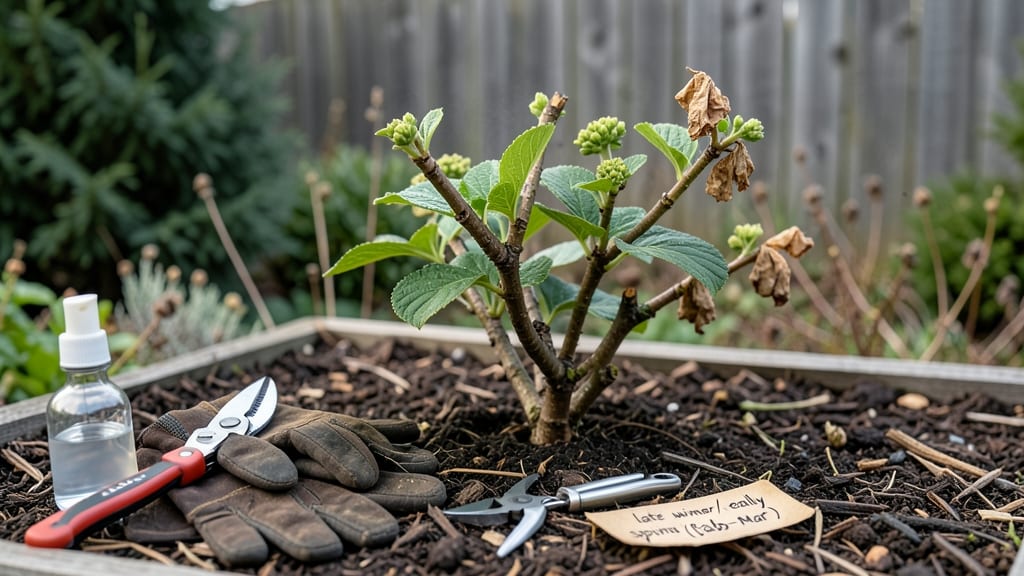
Cutting back bigleaf hydrangeas in late winter is the key to stronger blooms next season — and doing it too early or too late can ruin your 🌸 show.
If your bigleaf hydrangeas produce fewer blooms each year, the timing of your pruning could be the culprit. Cutting back at the wrong time can weaken growth or even eliminate next season’s flowers entirely.
Most gardeners wait until spring, but the best time is actually after the last frost but before new buds swell—typically late February to early March in USDA Zone 6a. This window ensures you prune while the plant is still dormant, avoiding damage to next year’s flower buds.
In this guide, I’ll walk you through the exact steps to prune for maximum blooms, regional adjustments for cold climates, and how to spot the perfect moment when your hydrangea is ready for a trim.
The best late-winter timeline for pruning big leaf hydrangeas
Pruning your big leaf hydrangeas (Hydrangea macrophylla) at the wrong time can mean the difference between a bush bursting with blooms and one that barely flowers. The key is understanding their dormant-season biology—these shrubs set next year’s flower buds on old wood in late summer and fall.
Cutting too early disrupts this process, while waiting too long risks overgrown, leggy growth.
Late winter is the sweet spot for pruning because the plant is fully dormant, and you can easily see the wood structure without leaves obscuring your view. This timing also minimizes stress on the plant compared to pruning in early spring when new growth begins.
The goal is to shape the shrub while preserving last year’s flower buds hidden along the stems.
| Stage | Action | Key Signs |
|---|---|---|
| Late Winter (USDA Zones 6-8) | Prune after last frost date but before bud swell | No green tips visible; branches appear completely bare |
| Early Spring (USDA Zones 9-10) | Prune 2-4 weeks after last frost | New green buds appear but no leaves |
| Cold Climates (Zones 3-5) | Wait until mid-to-late March for safety | Soil temperature consistently above 40°F |
| Mild Climates (Zones 9-10) | Prune January-February while dormant | No leaf drop yet; branches still leafless |
For most gardeners in USDA Zones 6-8, the ideal window is February through early March, right after the ground thaws but before bud swell begins. Look for brown, leafless branches with no green tips—this confirms dormancy.
In colder climates (Zones 3-5), wait until mid-March to avoid pruning too early when frost can still damage fresh cuts.
If you’re in a mild-winter zone (9-10), you can prune as early as January, but avoid cutting if your hydrangea has already dropped leaves—this signals early spring growth.
The critical mistake is pruning in late winter or early spring when buds begin to swell, as this removes next year’s flower buds before they’ve formed.
To identify the perfect moment, check for these three visual cues: no green tips on branches, no leaf buds, and soil that stays firm but workable when pressed. If you see tiny green buds or soft new growth, you’ve waited too long.
The goal is to prune when the plant is fully dormant but hasn’t yet started its spring awakening.
Regional adjustments matter—gardeners in Pacific Northwest (Zone 8) can often prune by late February, while those in Midwest states (Zone 5) should wait until after March 15. Use your local last frost date as a guideline, then add 2-3 weeks to ensure safety.
For example, if your last frost is April 10, aim to prune by March 20.
One common misconception is that pruning hydrangeas in late winter will kill the plant—the opposite is true. Pruning at this time stimulates stronger growth and better blooming by removing dead or crossing branches that compete for energy.
Just avoid over-pruning—never cut back more than 1/3 of the plant’s total volume, or you risk reduced flowering next season.
Pro tip: Mark your calendar 6 weeks before your last frost date to schedule your pruning.
This gives you time to sharpen your tools, research your specific hydrangea variety (some like 'Endless Summer' bloom on both old and new wood), and prepare to mulch heavily after pruning to protect roots from late-season frosts.
With the right timing, your hydrangeas will reward you with larger, more vibrant blooms all summer long.
🌸
Step-by-step pruning guide: how to cut for maximum blooms
Pruning your bigleaf hydrangeas (Hydrangea macrophylla) isn’t just about shaping—it’s about preserving next year’s blooms. Since these shrubs produce flowers on old wood, cutting too late or too aggressively can strip away next season’s buds entirely.
The key is precision pruning in late winter, combined with the right techniques to encourage healthy air circulation and vigorous new growth.
Start by gathering your tools: sharp bypass pruners, sterilized loppers for thicker branches, and gloves to protect your hands. Always sterilize your tools with rubbing alcohol or a 10% bleach solution to prevent spreading disease between cuts.
I also recommend keeping a small bucket handy to collect debris—this keeps your workspace clean and prevents pests from hiding in fallen leaves.
Before making any cuts, examine your hydrangea’s structure. Look for dead, diseased, or crossing branches—these should be removed first.
Dead branches are hollow or snap easily, while crossing branches rub against each other, creating wounds that invite pests. Never leave these behind—they’ll compete with healthy growth for nutrients and weaken your plant’s overall vigor.
⚠️ CALLOUT-WARNING ⚠️
Why it’s dangerous: Bigleaf hydrangeas bloom on old wood, meaning buds form on last year’s growth. Pruning after July 1st risks removing next year’s flower buds before they develop. Late pruning also stimulates tender new growth that can’t survive winter frosts, leaving your plant vulnerable to dieback and fungal infections.
What to do instead: Wait until late winter (February-March) when the plant is fully dormant. Look for brown, leafless stems—this is your cue to prune. If you missed the window, never cut more than 1/3 of the plant in early spring to minimize damage.
Now for the main event: shaping your hydrangea. Use your pruners to cut branches back to a bud or outward-facing branch. Always make cuts at a 45-degree angle, about 1/4 inch above the bud—this encourages water to run off and prevents rot.
For thicker branches, use loppers and cut just outside the branch collar, the swollen area where the branch meets the stem. Avoid leaving stubs, as they can trap moisture and lead to disease.
Focus on opening up the center of the shrub to improve air circulation. Dense centers trap humidity, creating ideal conditions for powdery mildew and botrytis blight. Remove up to 20-30% of the oldest stems each year to rejuvenate the plant.
If your hydrangea is overgrown or leggy, prioritize cutting back the longest, weakest stems first—they’re often the least productive and can shade out younger growth.
After pruning, step back and assess your work. Your hydrangea should have a balanced, open shape with room for new growth at the base. Avoid top-heavy cuts, which can make the plant unstable.
If you’re unsure, snap a photo before and after—it’s amazing how much difference a few strategic cuts can make! Finish by mulching around the base with 2-3 inches of organic mulch (like shredded bark) to retain moisture and protect roots as new growth emerges.
✂️ Remember: Patience is key. Bigleaf hydrangeas respond best to gradual pruning over time. If you’ve neglected pruning for years, don’t overhaul everything at once—focus on 10-15% of the plant per year to avoid shock.
With the right timing and technique, your hydrangea will reward you with larger, more vibrant blooms next season.