
Propagation
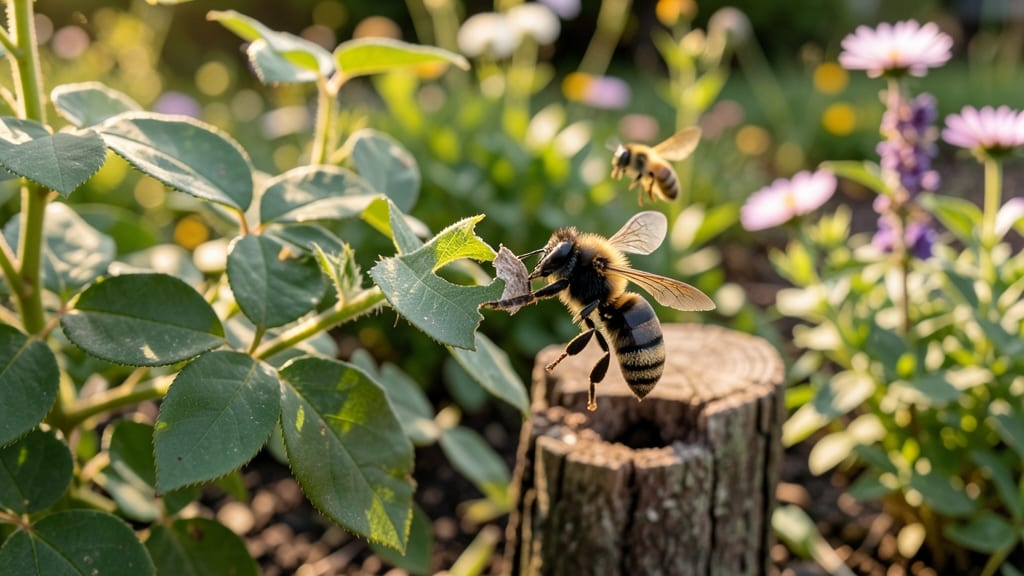
Leaf cutting bees do not sting humans, as their biology prioritizes nest-building over defense, unlike aggressive honeybees or wasps.
These gentle pollinators are more interested in collecting soft plant material for their underground nests than protecting themselves. 🌿 Unlike honeybees, which sting when threatened, leaf cutters lack the instinct to attack humans—making them perfect garden allies.
Their docile nature means you can safely observe them at work without fear of getting stung, though their leaf-cutting habits might leave your plants with distinctive notches.
Leaf cutting bees are solitary creatures, so their non-aggressive behavior stems from their focus on survival rather than territorial defense. This makes them ideal for pollination tasks without the risks associated with other bee species.
If you're wondering how to attract them, look for their signature work—clean, precise cuts along leaf edges—and provide nesting sites like drilled wooden blocks.
💡 In This Article
- Why Leaf Cutting Bees Avoid Stinging Humans
- Identifying and Encouraging Leaf Cutting Bees in Gardens
Why leaf cutting bees avoid stinging humans
Leaf cutting bees, scientifically known as Megachile species, have evolved to prioritize nest-building over defense due to their solitary lifestyle. Unlike honeybees, which live in colonies and must protect their hive, these bees operate independently.
Their stingers are primarily used for cutting soft plant material—like petals or leaves—to line their underground nests, not for attacking predators. 🌿 This biological adaptation means their stingers are underdeveloped for defense, making them incapable of delivering painful stings like their aggressive counterparts.
Their docile nature stems from their nesting habits: leaf cutters don’t compete for resources or territory, so aggression is evolutionarily unnecessary. Studies show that even when handled, these bees rarely sting unless severely provoked, unlike honeybees or wasps, which sting as a last-resort defense.
For comparison, a honeybee’s stinger is barbed and designed to tear from its body upon use, while a leaf cutter’s stinger is smooth and intended for precise cutting—not piercing skin.
Behaviorally, leaf cutting bees focus on efficiency rather than confrontation. They spend most of their time foraging for pollen and plant material, often visiting the same flowers repeatedly to maximize pollen collection.
This specialized diet—rich in protein and oils—supports their energy needs for nest construction, leaving little energy for territorial disputes. Their lack of aggression also makes them ideal pollinators for gardens, as they don’t disrupt plant growth or harm humans.
Another key factor is their size: most leaf cutting bees measure just 0.5 to 1 inch long, making them too small to pose a threat. Their delicate bodies are built for agility in tight spaces, not combat.
Even their nesting sites—often in pre-drilled wooden blocks or hollow stems—reflect their non-confrontational nature, as they avoid areas with high predator activity. This contrasts sharply with wasps, which actively patrol and defend their nests with venomous stings.
If you’ve ever spotted these bees in your garden, you might notice their precise leaf-cutting patterns: semi-circular notches along the edges of leaves, typically 0.25 to 0.5 inches wide. These cuts are a telltale sign of their presence and prove their focus on nest-building over defense.
Unlike honeybees, which leave behind sticky residue, leaf cutters leave clean, dry cuts that heal quickly on plants. 🌱
Their lack of aggression isn’t just a quirk—it’s a survival strategy. By avoiding unnecessary conflict, leaf cutting bees conserve energy for their primary goal: ensuring their offspring have a safe, well-lined nest.
This makes them one of the most beneficial—and harmless—pollinators for gardens, especially for plants like tomatoes, squash, and berries, which rely on their precise pollination.