
Trees
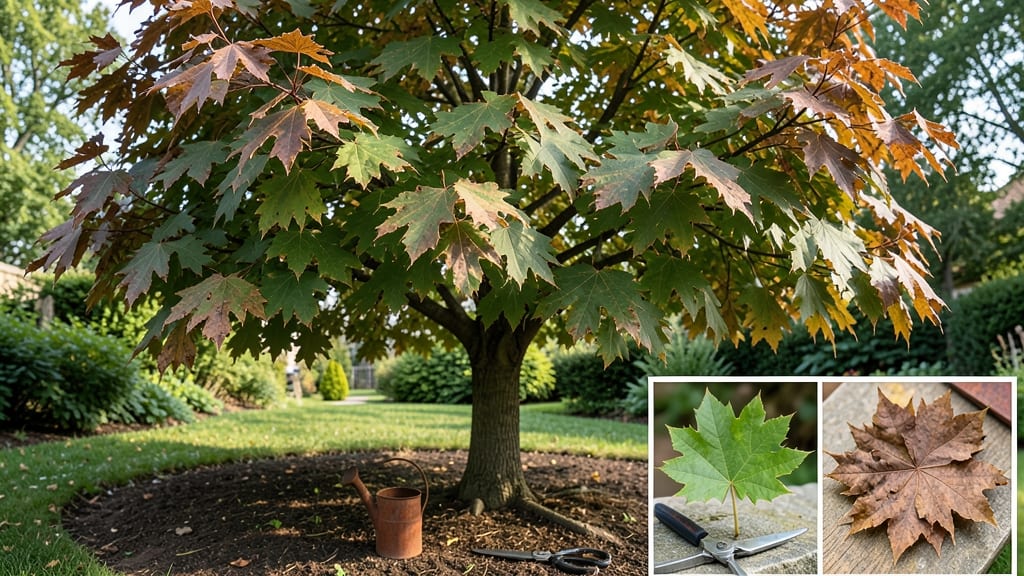
Crispy brown edges on your sugar maple leaves? 🌳 That’s classic leaf scorch—and copper fungicide can stop the damage in just 3 days if you act fast.
I’ve seen this happen after long dry spells or fungal infections, and the good news is you can reverse it with the right treatment.
The problem usually starts with drought stress or fungal spores spreading in hot weather. Leaves lose moisture quickly, edges crisp up, and the tree struggles to recover on its own.
The key is catching it early—before the scorch spreads to new growth—and using a targeted copper solution to protect the foliage.
Within 72 hours, you’ll notice fresh green growth pushing out from the damaged areas as the fungicide works. The tree will bounce back faster, and next season’s leaves stay vibrant. The trick is consistent watering and reapplying the copper every 10-14 days during dry spells.
This works for both young trees and mature ones, though larger trees may need a stronger concentration. The fix is simple but effective—no guesswork, just results. Let’s get those leaves looking healthy again.
Root Causes Of Leaf Damage
Understanding why sugar maple leaves develop those unsightly crispy, scorched edges is the first step toward fixing the problem. The condition—often called leaf scorch—is rarely caused by a single factor.
Instead, it’s usually a mix of environmental stressors, fungal infections, or improper tree care. Below, we break down the most common culprits and why they trigger this distressing symptom.
🍄 The Problem: While copper fungicides are a go-to solution for fungal diseases like anthracnose or tar spot, overapplication can backfire. Copper ions accumulate in the leaf tissue, disrupting cellular function and causing oxidative stress.
This leads to premature leaf browning, especially along the edges where copper concentrations are highest.
🔬 How It Works:
- Copper is a trace element that trees need in tiny amounts, but excess doses become toxic.
- Fungal spores (e.g., Rhytisma or Elsinoë) thrive in wet conditions, and repeated copper treatments can weaken the leaf’s natural defenses.
- Symptoms worsen in hot, dry weather when the tree struggles to dilute the copper buildup.
💡 Pro Tip: If you’ve applied copper fungicide recently and see scorch, flush the soil with water to reduce uptake. For severe cases, switch to a biological fungicide (like neem oil or potassium bicarbonate) to avoid further copper toxicity.
🌡️ The Problem: Sugar maples are sensitive to prolonged heatwaves and water deficits. When roots can’t supply enough moisture, leaves lose turgor pressure, and cells along the edges—being the oldest—desiccate first, turning crispy and brown.
📊 Key Triggers:
| Factor | How It Causes Scorch | Solution |
|---|---|---|
| High Temperatures | >90°F for days forces transpiration, drying edges | Mulch deeply (3–4") + drip irrigation |
| Low Humidity | Reduces stomatal function, trapping toxins | Mist leaves early morning (if mild) |
| Compacted Soil | Roots struggle to absorb water efficiently | Aerate soil + top-dress with compost |
💡 Pro Tip: Deep watering (1–2 inches per week) is better than frequent shallow watering. Test soil moisture by sticking a screwdriver in—if it resists past 3 inches, your tree is thirsty.
🌱 The Problem: Leaf scorch often signals a nutritional mismatch. While copper toxicity is a direct cause (as above), deficiencies in potassium, magnesium, or boron can also lead to edge browning. These nutrients regulate water retention and cellular repair.
🔍 Deficiency Red Flags:
- Potassium (K): Leaves scorch first along the margins, then yellow between veins.
- Magnesium (Mg): Interveinal yellowing (between veins) precedes crispy edges.
- Boron (B): New growth shows blackened, brittle tips before general scorch.
⚠️ Warning: Over-fertilizing with nitrogen-heavy products (like lawn fertilizer) can burn roots, exacerbating drought stress. Always use a balanced, slow-release fertilizer (e.g., 10-10-10) in early spring.
🚫 The Problem: Drift from glyphosate-based herbicides or road salt runoff (in urban areas) can cause non-specific leaf burn. Salt accumulates in soil, increasing osmotic pressure, while herbicides disrupt the leaf’s waxy cuticle, leading to rapid water loss.
🛡️ How to Protect Your Tree:
- Create a 3-foot buffer around the trunk when applying herbicides.
- Flush salt-affected soil with water in early spring (test soil pH—ideal for maples is 6.0–7.0).
- Avoid de-icing products with high sodium chloride near the root zone.
🐜 The Problem: Insects like maple leafhoppers, aphids, or scale inject toxins while feeding, triggering phyllody (leaf malformation) and scorch. Their saliva also clogs stomata, reducing the tree’s ability to regulate moisture.
🕵️ Signs of Pest Damage:
- Sticky honeydew on leaves (aphids).
- White, waxy shells on branches (scale).
- Yellow stippling between veins (leafhoppers).
💡 Pro Tip: A strong blast of water (hose-end nozzle) can dislodge many pests. For severe infestations, use neem oil or insecticidal soap—avoid systemic pesticides, which can stress the tree further.
✂️ The Problem: Over-pruning or poor cuts (tearing bark, leaving stubs) create wound sites where pathogens enter. Additionally, removing too many leaves reduces the tree’s ability to photosynthesize and regulate water, leading to scorch.
🌿 Pruning Do’s and Don’ts:
| Do | Don’t |
|---|---|
| Prune in late winter/early spring | Cut during drought or heatwave |
| Use clean, sharp tools (sterilize with rubbing alcohol) | Leave stubs >1/4 inch long |
| Remove dead/diseased branches first | Prune >25% of canopy in one year |
💡 Pro Tip: If you must prune in summer, water deeply the day before and after to minimize stress. Seal large wounds (>1/2 inch) with pruning sealant to prevent fungal entry.
Quick Fixes for Crispy Leaf Edges
When your sugar maple’s leaves start showing those telltale brown, crispy edges, it’s time to act fast. The good news? Many causes have simple, effective fixes—some even working in just 3 days with the right approach.
Below, we’ll map the most common triggers to practical solutions, so you can restore your tree’s health without stress.
If leaf scorch is caused by fungal pathogens (like Rhizoctonia or Venturia), copper-based fungicides are your best bet. These disrupt the fungus’s cell membranes, stopping the spread quickly.
How to Treat It
🔥 Step 1: Choose the Right Fungicide Use a copper fungicide (like Copper Sulfate 50 or Copper Hydroxide) or a fixed copper product (e.g., Bordeaux Mixture). Avoid organic sprays if the infection is severe—they may not be strong enough.
🍳 Step 2: Apply at the Right Time
- Best timing: Early morning or late afternoon (avoid midday sun, which can burn leaves).
- Frequency: Spray every 7–14 days until new growth appears healthy (usually 2–3 treatments for a full recovery).
- Coverage: Focus on both sides of leaves and the lower canopy, where fungi often hide.
👨🍳 Step 3: Clean Up Debris Remove fallen leaves, twigs, and infected branches (sterilize pruners with rubbing alcohol between cuts). Fungi overwinter in debris, so bag and dispose of it in the trash—not the compost!
⏰ Step 4: Monitor for 3 Days If you’re using copper fungicide, you should see slowed browning within 3 days and full recovery in 2–3 weeks. If not, switch to a systemic fungicide (like Propiconazole).
💡 Pro Tip: Mix 1 tsp baking soda + 1 tbsp horticultural oil + 1 quart water as a preventative spray (fungi hate alkaline environments!).
Drought or irregular watering causes leaves to dry out from the edges inward. Sugar maples hate wet feet and dry roots—balance is key.
How to Fix It 🔥 Step 1: Water Deeply (But Not Too Much)
- For drought stress: Water slowly at the base (1–2 inches per week, including rain). Use a soaker hose to avoid runoff.
- For overwatering: Let the soil dry out 2–3 inches deep before watering again.
Test with a screwdriver—if it slides in easily, you’re overdoing it.
🍳 Step 2: Improve Soil Drainage If your maple sits in clay or compacted soil, amend with:
- Compost (3–4 inches around the base)
- Sand or perlite (mix into the top 6 inches of soil)
- Organic mulch (wood chips or shredded bark, 3–4 inches thick, 3 feet from the trunk)
👨🍳 Step 3: Adjust Watering Schedule
- Young trees (under 5 years): Water 2–3 times per week in dry spells.
- Mature trees: Water once every 10–14 days (unless in extreme heat).
- Best time: Early morning (reduces evaporation and fungal risk).
⏰ Step 4: Watch for Recovery With proper hydration, new leaves should unfurl green within 5–7 days. If scorch persists, check for root rot (mushy, discolored roots = time for a soil test).
💡 Pro Tip: Install a rain gauge near your tree to track moisture levels. Sugar maples thrive with consistent, deep watering—not sporadic drenching!
Scorching from intense sun, wind, or pollution is often preventable with simple adjustments.
How to Protect It
🔥 Step 1: Provide Afternoon Shade If your maple is in a full-sun spot, add:
- A lightweight shade cloth (30–50% coverage) for 2–4 hours post-noon.
- Nearby trees or structures (but avoid blocking all light—maples need 6+ hours of sun).
🍳 Step 2: Windbreaks for Young Trees
- Plant evergreens or shrubs on the windward side (north or west in the Northern Hemisphere).
- Use a temporary windscreen (like a burlap barrier) if planting new saplings.
👨🍳 Step 3: Reduce Air Pollution Exposure
- Avoid fertilizing heavily near the tree (excess salts burn roots).
- If near a road or industrial area, rinse leaves monthly with water to remove dust/pollutants.
⏰ Step 4: Mulch for Root Stability A 3-inch layer of mulch (but not touching the trunk) helps retain moisture and insulate roots from temperature swings.
💡 Pro Tip: Mist leaves on extremely hot days (like 90°F+) to temporarily cool them down. Use a hose with a fine spray in the early morning.
Sap-sucking pests (aphids, mites, scale) weaken leaves, making them prone to scorch. A gentle but effective approach is key.
How to Eliminate Pests
🔥 Step 1: Spray with Neem Oil Mix 1 tbsp neem oil + 1 tsp mild soap + 1 quart water. Spray every 5–7 days until pests vanish. Best for: Aphids, mites, and young scale infestations.
🍳 Step 2: Introduce Predatory Insects
- Ladybugs (eat aphids)
- Lacewings (devour mites)
- Parasitic wasps (target scale insects)
Order from garden centers or release store-bought beneficial bugs at dusk.
👨🍳 Step 3: Prune Infested Branches Cut and dispose of heavily infested limbs (don’t compost!). Sterilize pruners with rubbing alcohol between cuts.
⏰ Step 4: Monitor for Regrowth If pests are under control, new leaves should emerge unscathed in 7–10 days. If not, switch to a pyrethrin-based insecticide (last resort).
💡 Pro Tip: Hose off pests with a strong stream of water in the early morning. Many bugs wash away before they can cause damage!
Yellowing between veins (with brown edges) often signals magnesium (Mg) or potassium (K) deficiency.
How to Restore Balance
🔥 Step 1: Conduct a Soil Test Send a soil sample to your local extension office (costs ~$20–$50). They’ll tell you exactly what’s missing.
🍳 Step 2: Apply the Right Fertilizer - For magnesium deficiency: Sprinkle Epsom salt (magnesium sulfate) around the base (1 tbsp per foot of tree height).
Water in well. - For potassium deficiency: Use a balanced fertilizer (like 10-10-10) or wood ash (sparingly—test pH first!). - For iron/chlorosis: Apply chelated iron (spray or granular).
👨🍳 Step 3: Improve Soil pH Sugar maples prefer slightly acidic soil (pH 6.0–7.0). If your soil is too alkaline:
- Add peat moss or sulfur to lower pH.
- Avoid lime or wood ash (raises pH).
⏰ Step 4: Wait for New Growth With proper nutrients, new leaves should appear green in 2–
Frequently asked questions about sugar maple leaf scorch
Why do sugar maple leaves turn brown only at the edges?
This classic "scorched" look happens when leaf edges lose moisture faster than the center. It’s usually caused by drought stress, fungal infections, or nutrient deficiencies like potassium or magnesium. The oldest cells along the edges dry out first when the tree can’t supply enough water.
Can copper fungicide actually make leaf scorch worse?
Yes! Overusing copper fungicides can cause copper toxicity in leaves, leading to browning. If you’ve applied copper recently and see scorch, flush the soil with water to reduce uptake. For severe cases, switch to neem oil or potassium bicarbonate instead.
How often should I water a sugar maple during a heatwave?
During extreme heat (90°F+), water deeply 2–3 times per week (1–2 inches total). Use a soaker hose at the base in early morning to avoid evaporation. Test soil moisture—if a screwdriver slides in past 3 inches, your tree needs more water.
What’s the fastest way to tell if leaf scorch is from drought or fungus?
Check the underside of leaves. Fungal scorch often shows black spots or powdery residue, while drought scorch leaves the undersides dry but clean. Also, fungal damage usually starts on lower branches first.
Will pruning help my sugar maple recover from scorch?
Only prune dead or severely damaged branches—never remove more than 25% of the canopy at once. Focus on late winter/early spring pruning to avoid stressing the tree further. Always sterilize tools between cuts to prevent spreading disease.