
Trees
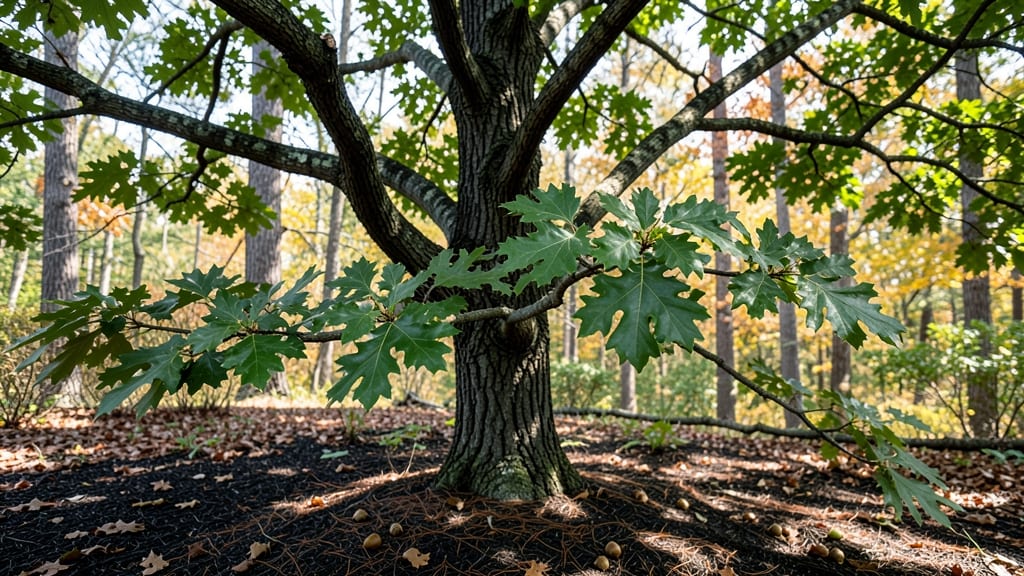
Swamp oak leaf identification is made easy by their distinctive deep lobes and pronounced ridges that set them apart from other oaks. 🌳 I've spent years studying these trees, and the key is noticing how the lobes curve inward more sharply than white or red oak leaves—almost like a rounded "U" shape.
The edges have a slightly fuzzy texture, and mature leaves develop a glossy sheen that catches the light differently than similar species.
The size alone gives it away: swamp oak leaves are 6-8 inches long, with 5-7 lobes that feel almost sculpted. Young leaves start out bronze or reddish before turning deep green, while mature leaves develop a distinctive silvery underside.
This trait helps distinguish them from pin oaks or willows that might grow nearby in wetland areas.
Knowing these details helps you plant the right tree for your landscape or wetland restoration project. Swamp oaks thrive in soggy soils where others fail, making them perfect for floodplains or rain gardens.
Their leaves also resist disease better than many ornamental oaks, which is why they're prized in conservation plantings.
For those in the Southeast, this identification becomes especially useful during fall leaf-peeping season. The leaves turn a rich golden-brown before dropping, creating stunning contrast against other fall foliage.
Compare them side-by-side with white oak leaves—you'll notice the swamp oak's lobes never have the rounded "bristle-tipped" look of its cousin species.
Understanding Leaf Stress Factors
Swamp oak leaves (Quercus michauxii and related species) develop their iconic ridges and lobes as a response to environmental pressures, genetic traits, and ecological adaptations. While these features are often celebrated for their beauty, they can also signal underlying stress or health issues.
Below, we break down the key reasons why swamp oak leaves may exhibit variations in shape, color, or texture—and how to recognize them.
🌱 Why it happens: Swamp oaks are genetically programmed to produce deeply lobed, ridged leaves as a survival mechanism. Unlike their upland relatives (e.g., white oak or red oak), swamp oaks thrive in waterlogged, nutrient-rich soils, where their broad leaves maximize photosynthesis in low-light conditions.
- Lobe development: The exaggerated ridges and sinuses (the "finger-like" indentations) help prevent waterlogging by allowing excess moisture to drain quickly.
This trait is hardwired into their DNA. - Leaf thickness: Swamp oaks often have leathery, glossy leaves—another genetic adaptation to resist fungal infections in humid environments. - Variation by age: Younger trees may have smoother, less lobed leaves, while mature specimens develop the classic 7–11 deep lobes (a hallmark of Quercus michauxii).
💡 Pro Tip: If you’re identifying a swamp oak, look for asymmetrical lobes (unlike white oak’s rounded lobes) and prominent veins that extend into the ridges.
🌊 Why it happens: Swamp oaks are specialized for wetlands, but when conditions stray from their ideal range, leaves react visibly. Common stressors include:
| Stressor | Leaf Response | What It Means |
|---|---|---|
| Drought | Curling, brown edges, smaller lobes | The tree conserves water by reducing leaf surface area. |
| Flooding | Yellowing (chlorosis), wilting | Root oxygen deprivation (anoxia) disrupts nutrient uptake. |
| Poor Soil Drainage | Dark, mushy spots on leaves | Fungal infections (e.g., Phytophthora) thrive in waterlogged roots. |
| Nutrient Deficiency (e.g., iron, nitrogen) | Pale yellowing between veins (iron) or stunted growth | The tree struggles to produce chlorophyll or sustain leaf expansion. |
🔥 Key Sign: If leaves develop unusually smooth edges or fewer lobes, it may signal nutrient starvation or compaction stress from heavy soil.
🐛 Why it happens: Swamp oaks are not immune to pests and pathogens, which can distort leaf shape, discoloration, or premature drop. Common culprits include:
- Oak leaf blister gall (Taphrina caerulescens):
- Symptoms: Thickened, warty, or blistered leaf surfaces (often purple or red).
- Why? A fungal infection that alters leaf cell growth, creating abnormal ridges or bumps.
- Lace bugs (Corythucha spp.):
- Symptoms: White, lace-like stippling on leaf undersides; yellowing between veins.
- Why? These sap-sucking insects starve leaves of nutrients, leading to weakened lobes.
- Anthracnose fungus (Gloeosporium spp.):
- Symptoms: Dark, sunken spots with concentric rings; leaves may develop irregular, jagged edges.
- Why? The fungus blocks water and nutrient transport, causing tissue death.
✨ Early Action: If you spot unusual dark spots or webbing, prune infected leaves and apply copper fungicide (for fungal issues) or neem oil (for pests).
🌪️ Why it happens: Swamp oaks in floodplains or storm-prone areas often suffer physical trauma that alters leaf development:
- Wind or hail scars: Leaves may develop ragged, torn lobes or scabbed edges where tissue is damaged.
- Herbicide drift: If nearby lawns are treated with glyphosate or 2,4-D, swamp oaks can absorb residues, leading to:
- Cupped or twisted leaves
- Stunted lobe growth
- Animal browsing: Deer or insects (e.g., caterpillars) may chew irregular edges, mimicking disease symptoms.
🎯 Tell-Tale Sign: Look for uneven damage—if only one side of the tree shows distorted leaves, it’s likely environmental (e.g., wind exposure) rather than systemic.
Quick Fixes for Leaf Confusion
Identifying swamp oak leaves can feel like solving a puzzle—especially when their lobed edges and wavy ridges blend with other oak varieties. But with the right approach, you can differentiate them confidently and avoid common mix-ups.
Below are practical solutions tailored to the most frequent challenges, from misidentifying similar oaks to dealing with seasonal changes.
Cause: Swamp oaks (Quercus michauxii and Quercus lyrata) share traits with willow oaks, water oaks, or even pin oaks, making them hard to distinguish at first glance.
Fix:
- 📏 Measure the lobes: Swamp oak leaves have 5–7 rounded lobes with sinuses that don’t reach the midrib (unlike willow oaks, which have deeper, narrower lobes). Use a ruler or your fingers to trace the depth—if the "valleys" between lobes are shallow, it’s likely a swamp oak.
- 🌊 Check the underside: Swamp oak leaves often have rusty-brown, star-shaped hairs (especially on young leaves). Flip the leaf over—if you see fuzzy texture, you’re on the right track.
- 🌳 Compare bark: Mature swamp oaks develop deep, blocky ridges on their bark. If the tree’s trunk looks like a textured fortress, that’s a strong clue.
Prevention Tip: 💡 Carry a small field guide or use a phone app (like iNaturalist or LeafSnap) to cross-reference findings on the spot. A quick photo comparison can save hours of guesswork!
Cause: Leaves change color, size, and even shape as seasons shift, making identification trickier in fall or early spring.
Fix:
- 🍃 Focus on spring/summer leaves: Young swamp oak leaves emerge bright green and slightly fuzzy, while mature leaves turn darker green with smoother edges. Avoid judging by fall’s golden hues—those are unreliable.
- 🌿 Look for "skunk stripes": Some swamp oaks (like Q. lyrata) have pale yellow or white stripes along the midrib when young. This fleeting trait is a dead giveaway in early summer.
- 📅 Time your visits: Early summer (June–July) is peak identification season when leaves are fully formed but not yet stressed by drought or pests.
Pro Tip: 🌡️ Avoid identifying in extreme weather. Heat or drought can distort leaf shape, while frost may cause premature browning—both can mimic disease or pest damage.
Cause: Spider mites, oak leaf blister, or fungal infections can alter leaf appearance, making you doubt your identification.
Fix:
- 🔎 Inspect the damage pattern:
- Blisters or scabs? → Likely a fungal issue (e.g., Taphrina blight), but the lobe structure remains intact—still a swamp oak!
- Yellow stippling? → Spider mites, but check the lobe shape and underside hairs to confirm the species.
- Holes or chew marks? → Insect larvae (like sawflies), but the overall leaf architecture stays key.
- 🚫 Don’t rely on damaged leaves alone. Focus on undamaged sections of the leaf to assess true traits.
Prevention Tip: ✨ Treat pests early. A neem oil spray (for mites) or pruning infected branches (for fungus) keeps leaves healthy—and easier to ID.
Cause: You’re in the field with no expert nearby, and visual memory isn’t enough.
Fix:
- 📱 Use apps with AI identification:
- LeafSnap (free) – Upload a photo for instant oak species suggestions.
- PictureThis (paid) – Provides detailed descriptions and growth habits.
- 🖼️ Compare with high-res images:
- USDA Plants Database ([plants.usda.gov](https://plants.usda.gov)) has labeled swamp oak leaf scans.
- iNaturalist ([inaturalist.org](https://www.inaturalist.org)) lets you post photos for community verification.
Pro Tip: 🎯 Take photos from multiple angles—top, bottom, and side views—to cover all identification bases.
Final Reminder: Swamp oaks are resilient and distinctive once you know what to look for. Start with lobe shape and underside texture, then verify with bark, growth habit, and seasonal traits. With practice, you’ll spot them in seconds!
Frequently asked questions
How do swamp oak leaves differ from water oak leaves?
Swamp oak leaves have 5-7 rounded lobes with shallow sinuses that don't reach the midrib, while water oaks have 5-7 bristle-tipped lobes with deeper sinuses. Swamp oaks also feature a distinctive silvery underside with rusty hairs, whereas water oaks have smoother, paler undersides.
Can I identify swamp oak trees by their leaves in winter?
No, winter identification is nearly impossible since swamp oaks lose their leaves. Look for deep, blocky bark ridges and acorn clusters instead. The acorns are smaller than white oak acorns (1/2 to 3/4 inch) with a shallow cap.
Why do some swamp oak leaves have fewer lobes than others?
Young trees or stressed specimens often produce leaves with fewer lobes (sometimes just 3-5). This happens due to environmental factors like drought, poor soil, or pest damage. Mature trees typically develop the classic 7-11 deep lobes when conditions are ideal.
Are swamp oak leaves poisonous to pets?
No, swamp oak leaves are not toxic to pets. While oak trees can cause mild stomach upset if ingested in large quantities, the leaves themselves are not poisonous. However, acorns contain tannins that may cause vomiting if eaten in excess.
How do I distinguish swamp oak from willow oak?
Willow oaks have slender, willow-like leaves with narrow, elongated lobes that look more like fingers. Swamp oaks have broader, rounded lobes with a more sculpted appearance. Also check the bark—willow oaks have smoother bark compared to swamp oak's blocky ridges.