
Plants
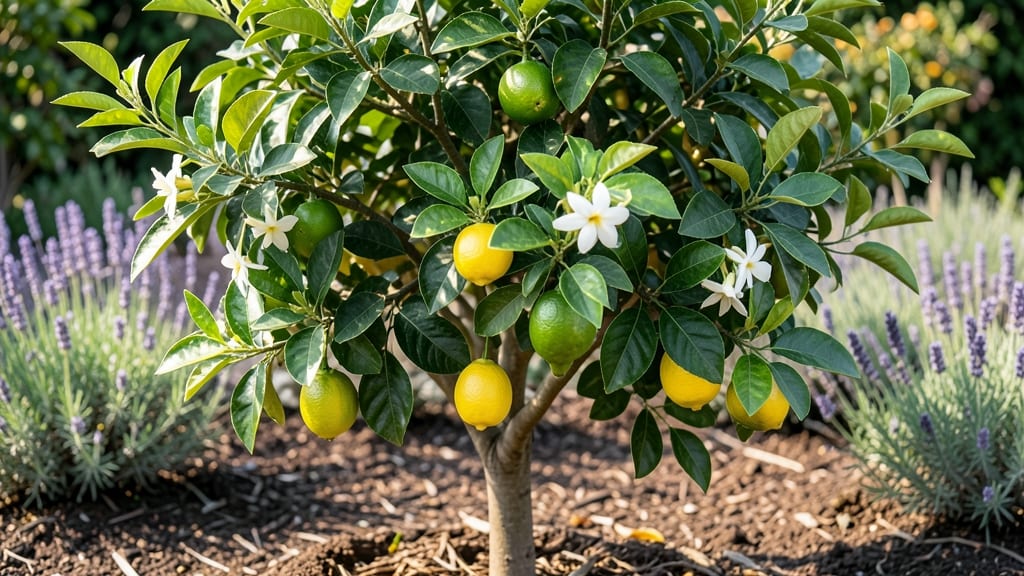
A lemon tree leaf looks like an elongated oval with a sharp point at the tip, featuring glossy dark green surfaces and jagged edges along its perimeter. These leaves typically grow 2-4 inches long and have a thick, slightly waxy feel that distinguishes them from other citrus varieties.
A lemon tree leaf's distinctive appearance starts with its oval shape, which tapers to a sharp point at the end—almost like a miniature spear. 🌿 The serrated edges and leathery texture make them easy to identify, especially when compared to smoother citrus leaves.
Young leaves begin lighter green before maturing into the rich, deep hue that's characteristic of healthy lemon trees.
What sets lemon tree leaves apart is their glossy finish, which reflects light differently than the matte surfaces of some other citrus plants. The thick, waxy coating not only gives them that signature shine but also helps conserve moisture—a clever adaptation for their Mediterranean origins.
When you run your fingers along the edges, you'll notice the tiny teeth along the serrations, which are more pronounced than those on lime or orange leaves.
💡 In This Article
- Identifying Lemon Tree Leaves vs Citrus Relatives
- Caring for Lemon Tree Leaves: Signs of Health and Stress
Identifying lemon tree leaves vs citrus relatives
The most reliable way to distinguish lemon tree leaves from other citrus varieties is by examining their vein pattern and leaf shape. Lemon leaves feature prominent, parallel secondary veins that run almost straight from the central midrib, creating a ladder-like appearance.
This pattern differs from lime leaves, which have more pronounced, curved veins that create a feathery look. The angle between the leaf blade and stem (petiole) in lemons is also wider—around 60-70 degrees—compared to the tighter 45-degree angle of orange leaves.
Size and edge details offer additional clues. Lemon leaves typically measure 2-4 inches long with 1-2 inches width, while grapefruit leaves are broader (up to 3 inches wide) and have smoother, less pronounced serrations.
The waxy coating on lemon leaves is thicker than on oranges, giving them a slightly raised, almost bumpy texture when viewed under light. 🌿 Another key difference is scent: Crush a lemon leaf and you'll get a bright, tangy aroma, whereas lime leaves smell more herbal and slightly bitter.
For gardeners, understanding these distinctions helps prevent misidentification during pruning or pest control. For example, spider mites target stressed citrus leaves, and knowing which plant you're dealing with ensures you use the right treatment.
Lemon leaves also have a unique resinous quality—when damaged, they exude a clear, sticky sap that's more pronounced than in other citrus varieties.
Here's a quick visual comparison:
- Lemon: Oval, pointed tip, 2-4" long, glossy dark green, prominent parallel veins, 60-70° petiole angle
- Lime: Elliptical, rounded tip, 1.5-3" long, lighter green, curved veins, 45° petiole angle
- Orange: Broad oval, blunt tip, 3-5" long, matte finish, smooth serrations, thinner texture
The leaf arrangement also differs—lemon trees have alternate leaves (one leaf per node), while some citrus varieties like trifoliate orange have compound leaves with multiple leaflets. This becomes especially useful when identifying young trees before fruit appears.
One pro tip: Hold leaves up to a light source to see the vein patterns clearly. The translucent quality of lemon leaves when backlit reveals their intricate vascular structure, which is more visible than in thicker grapefruit leaves. This simple technique can help even novice gardeners make accurate identifications.